
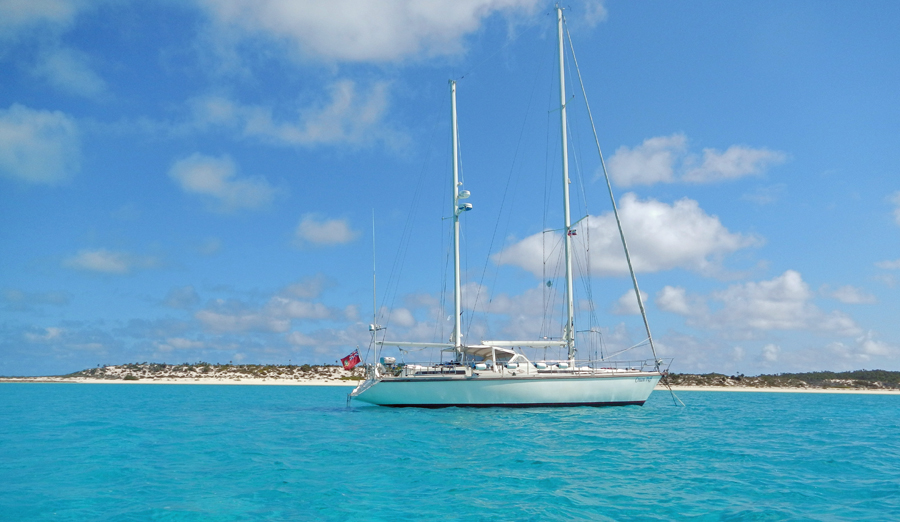
Cream Puff at Anchor
The idea of working from a boat while exploring the world feels like the ultimate freedom. With Starlink providing reliable, high-speed internet almost anywhere on the globe, the technical barrier has effectively disappeared. You can take video calls from an anchorage in the Caribbean, upload large files from a quiet bay in the Med, or manage a YouTube channel from the South Pacific. Connectivity is no longer the weak link.
Not everyone will welcome the perspective that follows. Many in the sailing community will argue that the risks are exaggerated, pointing out they’ve been working from their boats for years without a single problem. Others will say that focusing on immigration rules and tax obligations kills the very dream that makes cruising so appealing in the first place. Some long-term sailors pride themselves on quietly working under the radar, convinced that common sense is all that’s needed. Retirees who live on pensions and savings may wave this all away, since they feel the warnings don’t apply to them. Sailing bloggers or YouTubers, whose income often depends on monetized content produced abroad, might object to the spotlight being turned on legal grey areas they’d rather not discuss.
But the reality is unavoidable. Governments do care. Enforcement is increasing, especially as countries look for revenue sources. And the consequences can be serious. While some readers may dismiss this as overly cautious, others — especially those planning their first long-term cruise or considering remote work at sea — will appreciate a frank look at the hidden pitfalls.
The challenges of working from a boat were never just about technology. The real obstacles lie in immigration law, employment compliance, and tax regimes. These are invisible issues, but they carry consequences far heavier than a dropped Zoom call.
The Legality of Working Abroad
When you sail into another country, your right to be there is dictated by your visa. Tourist visas are designed for leisure, short visits, and basic business travel like attending meetings or conferences. They are not in any way designed for earning income. When entering a foreign country, visitors are typically required to declare the purpose of their stay — employment, tourism, study, and so on.
Authorities generally define “work or employment” as any activity for which you are paid, regardless of where the employer is located. This means that even if you are freelancing for clients abroad, running a monetized YouTube channel, or blogging for ad revenue, you are technically working in the country where your boat is anchored. Without the correct visa, this falls outside the scope of what you are legally allowed to do.
By contrast, income from investments, pensions, or savings is usually treated differently. If you can support yourself through dividends, retirement withdrawals, or bank balances, this is not considered “work or employment.” That is why many visitor visa applications ask for proof of funds or a source of income. The distinction is straightforward: if you’re providing a service or labor while physically present, it’s work. If you’re merely living off money already earned elsewhere, it isn’t.
Countries that recognize the rise of remote work have created digital nomad visas precisely because their existing visa categories do not cover this situation. Spain, Portugal, Greece, Barbados, Antigua and Barbuda, Dominica, Grenada, and several other jurisdictions now issue permits that explicitly allow foreign nationals to live locally while working for overseas clients or employers. A quick search will reveal countries with nomad visas, the most common slang term.
Risks to the Employer
For employees, the risk often feels personal. They might think they are taking all of the risk themselves. But employers also face significant exposure. A worker sitting in a foreign country for an extended period can create what is known as a permanent establishment. Tax authorities may then argue that the employer is conducting business in that jurisdiction, triggering local corporate tax obligations, payroll tax, and social security contributions.
It’s not just theory — there’s precedent. Land-based digital nomads have already been caught, and in some cases their employers paid the price. Several companies were fined when contract employees were discovered living abroad while working remotely without notifying the host country, creating unexpected tax and compliance liabilities. Even within the United States, state tax authorities have flagged remote workers traveling in RVs and working across state lines, treating them as taxable residents. These examples show that governments are paying attention, and enforcement is not limited to dramatic deportation stories overseas.
Even without a permanent establishment claim, some countries can fine employers for allowing staff to work without appropriate authorization. Larger multinationals often have policies banning remote work from certain countries precisely to avoid these risks. Smaller firms may not even realize they are exposed until they receive a letter from a foreign tax office.
Employment law is another layer of complication. Many countries give workers specific protections under their local laws if they are deemed to be employed within that jurisdiction. These can include minimum wage requirements, mandatory paid leave, working-time restrictions, health and safety obligations, and dismissal protections. In the EU, for example, a worker habitually performing their duties from within a member state may be entitled to that state’s employment rights, regardless of what the employment contract says.
For employers in heavily regulated industries — finance, healthcare, education, defense contracting — there may also be restrictions on where employees can perform work due to data protection laws or security rules. Allowing staff to operate from foreign jurisdictions can raise compliance concerns that go well beyond payroll or taxes.
This is why honesty with your employer matters. If you intend to work from abroad, discuss it openly. Some companies may be willing to manage the compliance burden. Others will flatly refuse. Hiding behind a VPN to disguise your location may get you past IT filters, but it does not erase the legal risk. If authorities come knocking, both you and your employer could suffer consequences.
Tax Complications
The tax issues are often more damaging than the visa questions. Many countries apply a 183-day rule: spend more than half the year within their borders and you are deemed a tax resident, liable for income tax. Some jurisdictions apply shorter tests, looking at “habitual presence” or “center of vital interests.” In the Caribbean islands, this is probably a non-issue since people move frequently to another island or country.
However, in places like French Polynesia, this is a real issue. Most non-EU cruisers will stay for two years on an extended visa and carte de séjour. Or, perhaps a cruiser might roll the dice in cyclone season and stay in a place like Fiji for an extended time.
For U.S. citizens, there is no escape from the IRS. All worldwide income must be declared, including blog revenue, YouTube monetization, or freelance earnings. The Foreign Earned Income Exclusion (FEIE) and the Foreign Tax Credit can reduce or offset double taxation, but only if you qualify under the rules. If you trigger residency in another country without realizing it, you could find yourself facing two tax authorities with competing claims.
Employers also face possible obligations. If local authorities decide you are working from their soil, they may insist that both you and your employer contribute to social security or pension schemes. This is administratively complex and expensive, which is why many employers refuse to allow staff to work indefinitely from abroad.
Visa Options and Why They’re Tricky for Sailors
Many countries now offer digital nomad or remote work visas that make it legal to earn income while living there. Spain and Portugal have introduced multi-year permits tied to minimum income and employer verification, while Germany’s freelance visa requires proof of demand for services and a business plan. In the Caribbean, islands like Barbados, Antigua, Dominica, Grenada, Montserrat, Curaçao, Anguilla, and St. Lucia all run programs designed to attract remote workers. These usually last from six months to two years, set annual income thresholds between USD 37,000 and 70,000, and require health insurance. Most also exempt foreign-sourced income from local taxation, and many require documentation from your employer or a corporate statement if you are self-employed.
On paper, these visas solve the immigration problem. In practice, they are aimed at expats who intend to settle in one place. For sailors moving from island to island, they create a bureaucratic maze: each new country means a new application, new fees, and new compliance rules. Once you sail away, the visa no longer applies. That leaves cruisers with two options — constantly juggle overlapping visa regimes at significant expense, or accept that much of the time they are technically working without authorization.
Has Anyone Ever Been Caught?
Yes. Remote workers have been denied entry, deported, or banned from working without authorization.
- In Bali, two Americans were deported in 2021 after openly promoting their “work from Bali” lifestyle online while on tourist visas. Their social media posts were used as evidence.
- In Thailand and Singapore, travelers have been refused entry after admitting at immigration that they were freelancing online.
- In Australia, people have been removed from the country for working online while on visitor visas.
- In Europe, companies have faced audits after employees quietly worked from another member state for extended periods, triggering questions about payroll tax and labor rights.
- I personally know of a mechanic who was deported from the Bahamas. While living on his own boat, he charged for engine work on other people’s boats and accepted only cash. He spent some time in jail during the deportation process. His USA passport was flagged after this incident, preventing him from freely traveling. The Bahamas also notified the IRS.
The common factor is visibility. People who blogged, posted videos, or admitted to working when questioned were the ones caught. Most who work quietly under the radar avoid attention, but it only takes one unlucky inspection — or one audit of your employer — for problems to surface.
Consequences of Countries Sharing Information
The risk is higher today because governments share data across borders. Immigration and tax authorities exchange passenger name records from airlines, visa histories, and even financial account details through agreements like the OECD’s Common Reporting Standard.
This has practical consequences:
- Immediate enforcement: you could be refused entry at the airport or denied re-entry into a country where you overstayed or worked without authorization.
- Retroactive penalties: tax authorities can demand back taxes, plus interest and fines, if they conclude you should have been paying locally.
- Blacklist effect: once flagged, you may find it harder to secure future visas, not just in the country where you broke the rules but in others that share information. This can quickly end a world travel plan.
- Employer exposure: audits may extend to your company, uncovering broader compliance failures and leaving them with penalties as well.
In short, “flying under the radar” is far less safe than it used to be.
The Illusion of Safety
Many remote workers dismiss the risks with a shrug, convinced they will not be noticed. And for a long time, that was true. But governments are becoming more proactive. Spain and Greece created new visas after realizing that large numbers of foreigners were already working without authorization. Others are beginning to enforce their existing rules more aggressively.
The truth is that blogging about your work or posting monetized videos is self-incrimination. You are documenting an immigration violation in public, timestamped, and often geotagged. It is not a question of if you could be caught, but when someone decides to connect the dots.
How to Do It Legally
First and foremost, I am not a lawyer, and this is not legal advice. It is possible to work from a boat and remain compliant, but it requires planning and often compromise.
- Choose a Digital Nomad Visa Where Available. Caribbean islands such as Barbados, Antigua, Dominica, Grenada, and Curaçao have created programs specifically for this lifestyle. They typically exempt foreign-sourced income from local taxation. European options like Spain and Portugal exist too, though they carry more bureaucracy.
- Limit Your Time in Any One Jurisdiction. By moving frequently and respecting stay limits, you may avoid triggering local tax residency. This is not a substitute for the correct visa but might reduce risk.
- Use an Employer of Record or Contractor Structure. If you work for a company that insists on compliance, an Employer of Record service can place you on a local payroll legally. For freelancers or content creators, establishing a legal business entity (for example, in your home country) and paying taxes there provides a paper trail to show authorities that your income is foreign-sourced.
- Stay Compliant With Home Country Taxes. USA citizens must file worldwide income tax returns regardless of where they are. Using the FEIE or the Foreign Tax Credit can help prevent double taxation if you end up paying locally as well. Other nationalities should check their own country’s residency rules and tax treaties.
- Be Transparent With Your Employer. If you are employed rather than self-employed, do not try to conceal your location with VPNs or vague travel stories. Employers have compliance responsibilities, and hiding your true whereabouts can put them in legal jeopardy. Transparency avoids both liability and mistrust.
- Avoid Broadcasting Violations. If you are not operating under the correct visa, do not blog or vlog about your monetized activities. This is just plain stupid. Publicly documenting violations makes them easier to enforce.
Final Thoughts
Working from a boat is now technologically effortless thanks to Starlink. But the legal, tax, and immigration framework is still written for a world where work is tied to land and borders. Every time you log in from a foreign harbor, you are subject to laws that may not recognize your lifestyle.
The rules described here reflect the law as written. In practice, enforcement varies widely. Some cruisers work under the radar for years without issue, while others have been caught quickly. The risks are real, but how often they materialize depends on where you are, how visible you make yourself, and how aggressively a given country enforces its rules.
Sailors who want to work while cruising have two choices: either invest the time and money to do it legally through the correct visas and tax structures, or accept that they are rolling the dice and may eventually pay a steep price. The glossy social media image of “digital nomad freedom” hides a far more complicated reality — one where governments, not the sea, may present the greatest danger.