A Childhood at Sea: Adventure or Selfishness?
Before We Get Started…
This article is going to upset a few people. I can already hear the responses: “Cities aren’t safe for children either.” “Our kids loved cruising.” “You don’t have children, so how would you know?” Fair points, but none addresses the question I’m raising: Should parents deliberately expose their children to the additional risks and compromises of long-term offshore cruising to pursue what is ultimately an adult’s dream?
I’ve sailed since childhood and spent thirteen years cruising full-time. I understand the lifestyle. And yes, I don’t have children. That doesn’t mean I can’t question decisions parents make on their children’s behalf. Parenthood provides experience I don’t have, but it doesn’t place every parental decision beyond criticism. In other words, you don’t have to be a parent to recognize when a parent’s pursuit of personal happiness may come at the expense of their child’s best interests.
I can tell you this: had my parents taken me away from school, friends and everything familiar to spend my childhood world cruising, I would have hated it. Knowing what I now know about life aboard, I might well have resented them well into adulthood. Not every child feels that way. Some genuinely love cruising. But parents cannot know how an enthusiastic eight-year-old will feel about that decision at fourteen or eighteen. The parents get to choose the dream. The children have to live it.
The Decision Isn’t Really the Child’s
Adults dream of escaping schedules, jobs, and routine. They imagine tropical islands, beautiful anchorages and freedom. A five-year-old didn’t make that choice, and that distinction matters. Cruising parents often describe the lifestyle as an extraordinary gift to their children. Perhaps it is. But it’s equally possible those children are making substantial sacrifices so their parents can pursue a dream.
One argument I frequently hear is, “We discussed it with our children, and they wanted to go.” I don’t find that particularly persuasive. Children should certainly be heard, but enthusiasm isn’t the same as informed judgment. The ability to weigh long-term consequences continues developing through adolescence and into adulthood.
Ask a ten-year-old whether they’d rather sail to tropical islands than attend school, and the answer may be predictable. But can that child appreciate what it means to lose close friendships, organized sports, school activities, privacy, and the ordinary experiences of growing up? More importantly, can they anticipate how they’ll feel about those sacrifices five years later, or more? That’s why “the kids agreed” doesn’t transfer responsibility from parents to children. Listening to a child’s wishes is important, but understanding the consequences that child cannot yet fully appreciate remains the parents’ responsibility.
The Safety Argument Is Difficult to Ignore
Children have died while cruising. I personally know of two incidents in which I believe basic precautions could have prevented those deaths. That doesn’t prove cruising children suffer more accidents than children ashore. Reliable comparative statistics are lacking. But it does establish that the dangers are real, and the consequences can be devastating. The children who died don’t get to write the blog.
Every childhood involves risk. The difference offshore is that relatively manageable emergencies can become life-threatening because help may be hundreds of miles away. Appendicitis, a severe allergic reaction, an infection or a serious injury may require treatment that simply isn’t available. Then there’s the boat itself: moving decks, heavy equipment, electrical systems, propane, winches, lines, booms and the constant possibility of someone going overboard. Many YouTube videos show cruising children on a yacht without life vests. These hazards aren’t necessarily unmanageable, but they’re concentrated in a confined, constantly moving environment, sometimes far beyond the reach of immediate assistance.
Experienced sailors understand these dangers and can manage them remarkably well. But even experienced sailors make mistakes, and for inexperienced parents my concern is considerably greater. Seamanship takes years to develop. Books and courses provide knowledge, but experience teaches judgment: recognizing deteriorating conditions, understanding a boat’s limitations and knowing when not to leave. Adults choosing to learn those lessons offshore accept the consequences themselves. Bringing young children along means those children share the consequences of mistakes they had no part in making. It’s difficult to see how parents can adequately protect their children from dangers they don’t yet fully understand themselves.
Childhood Is More Than Education
Cruising families often point to the extraordinary education their children receive, and they’re right about many of the benefits. Visiting different countries, experiencing cultures, learning languages and exploring the natural world can provide an education no classroom could duplicate. But childhood isn’t simply about acquiring knowledge. It’s also about friendships, independence, belonging and learning to function in a world beyond one’s parents.
It’s having a best friend, joining a team, attending birthday parties, arguing with classmates and learning to resolve differences. It’s developing relationships with teachers, coaches and other adults who become part of a child’s life. Cruising children certainly make friends, but boats move. One family sails east while another sails west. Temporary friendships, however wonderful, aren’t necessarily a substitute for relationships that develop over years. Nor can every aspect of childhood be replaced by visiting another beautiful island.
Homeschooling can provide an excellent academic education, but parents must also find the time and energy to deliver it consistently while operating, maintaining and provisioning an ocean-going sailboat. Some undoubtedly manage this very well. Others may discover that the practical demands of cruising leave considerably less time for education than they anticipated. Which is going to suffer most?
Watches, Childcare and Exhaustion
Anyone who has made long offshore passages understands the importance of sleep. On a two-person crew, one person stands watch while the other rests. Add young children, and that arrangement becomes considerably more complicated. If one parent is on watch, who’s caring for the children? If it’s the off-watch parent, when does that person sleep? During daylight hours, that same parent may be homeschooling, cooking, cleaning and supervising children instead of resting. Then they’re expected to take over responsibility for the boat.
A few days of good weather might make this manageable. After a week offshore, with accumulating fatigue and worsening conditions, it can become a serious safety concern. The ocean doesn’t make allowances for exhausted parents, and children don’t stop needing attention because the weather has deteriorated.
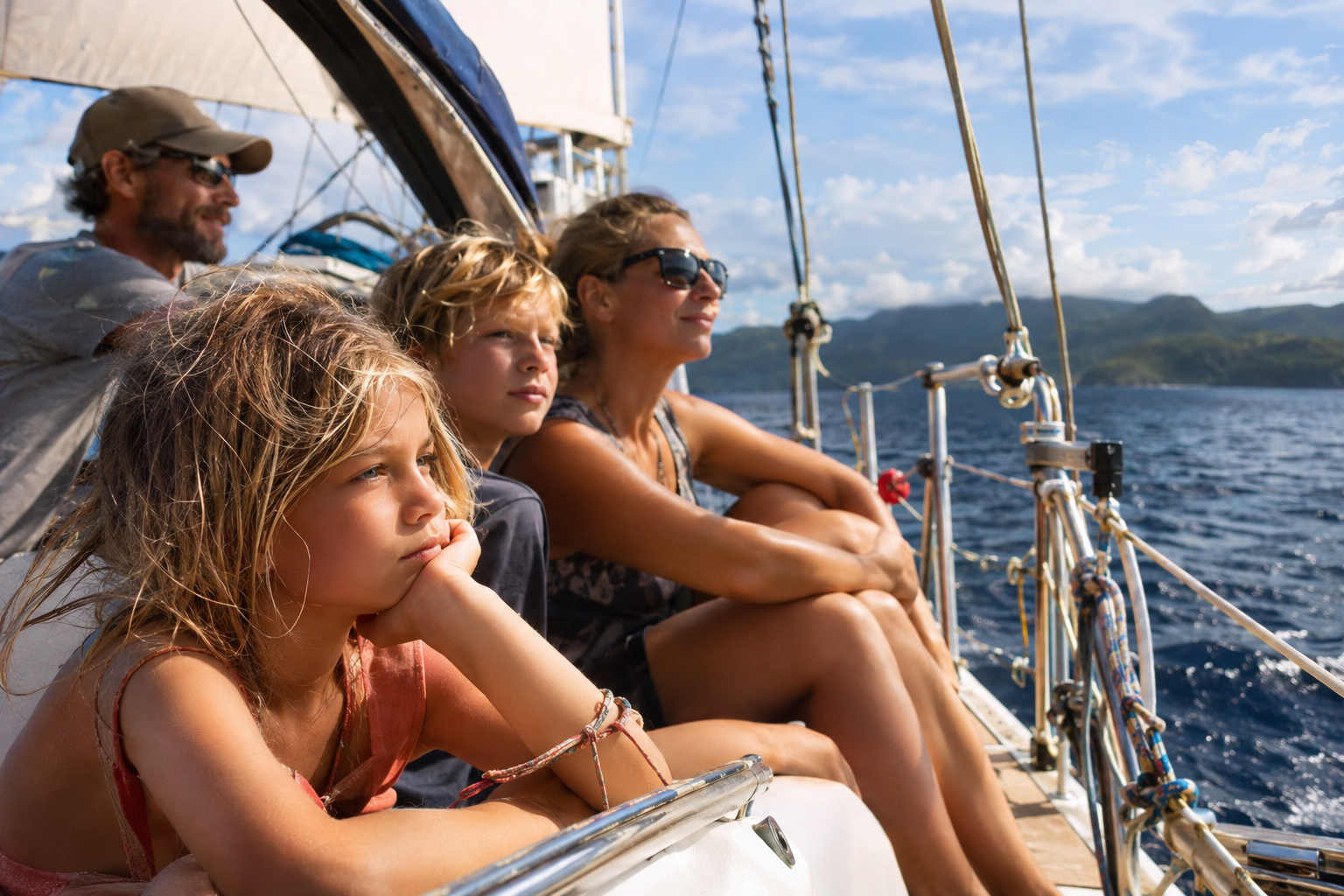
There’s also the workload. The romantic image is a family sharing an adventure. The reality can become one parent handling navigation, sailing and repairs while the other manages homeschooling, meals, laundry and childcare. That arrangement may work for some couples, but it deserves considerably more thought than the attractive photographs of children swimming in tropical anchorages tend to suggest. And what happens if one parent becomes incapacitated halfway across an ocean? Can the other safely operate the vessel while simultaneously caring for the children? These aren’t remote philosophical questions. They’re practical possibilities every cruising family should confront before departure.
Money Matters Too
Cruising is frequently portrayed as a simpler, cheaper lifestyle, but boats consume money. Engines fail, sails wear out, electronics break and rigging needs replacement. Insurance, haul-outs, communications and travel expenses accumulate, often at inconvenient moments. For financially secure families, this may be irrelevant. But if years of cruising consume savings that would otherwise support children’s education or future financial security, that’s another sacrifice worth acknowledging. Experiences have enormous value, but so does giving children a secure financial foundation and a solid formal education.
What Happens When the Children Want Something Different?
A toddler knows no other life. An eight-year-old might think living aboard is fantastic. A fourteen-year-old may desperately want friends, privacy, school activities and a bedroom that doesn’t move.
Here’s the contradiction I find particularly troubling. Some parents cite their children’s enthusiasm as justification for beginning the adventure. But what happens when those same children want to stop? If their opinion mattered enough to justify leaving, surely it should carry considerable weight when they ask to come home. Parents can’t reasonably claim, “The children wanted this too,” when everyone agrees, then retreat to, “We’re the parents and we make the decisions,” when the children change their minds.
Of course parents retain responsibility, but as children mature, their wishes deserve increasing consideration. If a child becomes genuinely unhappy, parents must ask whether continuing to cruise still serves that child’s interests. And if the answer is simply, “This is our lifestyle, and they’ll appreciate it someday,” perhaps it’s time to confront the question at the heart of this entire argument: whose dream is this, anyway?
A Good Outcome Doesn’t Prove It Was a Good Decision
Whenever this subject comes up, someone inevitably responds, “We did it, and our children turned out fine.” I don’t doubt it. Some cruising children become exceptionally confident, capable and worldly. They experience extraordinary places and develop close family relationships. Those are genuine benefits, and dismissing them would be unfair.
But a good outcome doesn’t necessarily prove the original decision was wise. Sailors should understand this better than most. Someone can depart despite a terrible weather forecast, complete a passage they probably shouldn’t have attempted and arrive safely. That safe arrival doesn’t prove leaving was prudent. It simply means the risks didn’t produce a bad outcome that time.
The same principle applies to raising children offshore. A happy cruising family doesn’t establish that cruising is generally better for children. We don’t know how those same children would have developed ashore. Perhaps cruising made them more independent and confident. Perhaps they would have developed those qualities anyway. There is no control group for somebody’s childhood.
Nor do sailing blogs and YouTube channels necessarily provide a balanced picture. We hear plenty from families who loved the experience and want to share it. Far less is heard from those who quietly abandoned their plans, struggled with education or relationships, or whose children wished they’d grown up differently.
I’m not arguing that children cannot thrive while cruising. Clearly, some do. I’m questioning what parents are entitled to assume before they know how the story ends. Parents have to make these decisions before the outcome is known, not afterward, when a successful experience can make the original risks seem less significant than they actually were.
The Dream Can Wait
Rejecting full-time offshore cruising for young children doesn’t mean raising them in a bubble. Take them sailing. Teach them navigation. Spend summers cruising. Travel internationally. Explore different cultures. Go diving, hiking and camping. There are countless ways to give children extraordinary adventures without making the pursuit of an adult’s dream the defining feature of their childhood.
Give them adventure, but also give them a stable home, lasting friendships, teachers, coaches and a community. Allow them to develop interests and relationships independent of their parents. When they’re older, they can decide for themselves whether crossing oceans is something they want to do.
There’s nothing wrong with dreaming about sailing around the world. I understand that dream better than most. But children are only children for a relatively short time, and the years spent growing up cannot be recovered or repeated. Parents have decades in which to pursue their ambitions. Children get only one childhood.
The ocean will still be there. The islands will still be there. The boat can wait. Sail with your children. Teach them to love the water. Take them on adventures. But when it comes to making an ocean-going sailboat their full-time home and taking them across oceans for years at a time, my view remains unchanged: wait until they’re old enough to make that choice for themselves.
There will be plenty of time to sail over the horizon later.
About the Author:
A lifelong sailor, Mark Clayton spent thirteen years living aboard and cruising the world’s oceans with his wife Cindy. His firsthand experience of the cruising lifestyle gives him a perspective on both its extraordinary rewards and its often-overlooked realities. The account of Mark and Cindy’s adventure aboard their ketch 53’ Amel Super Maramu ‘Cream Puff’ can be found here: www.creampuff.us