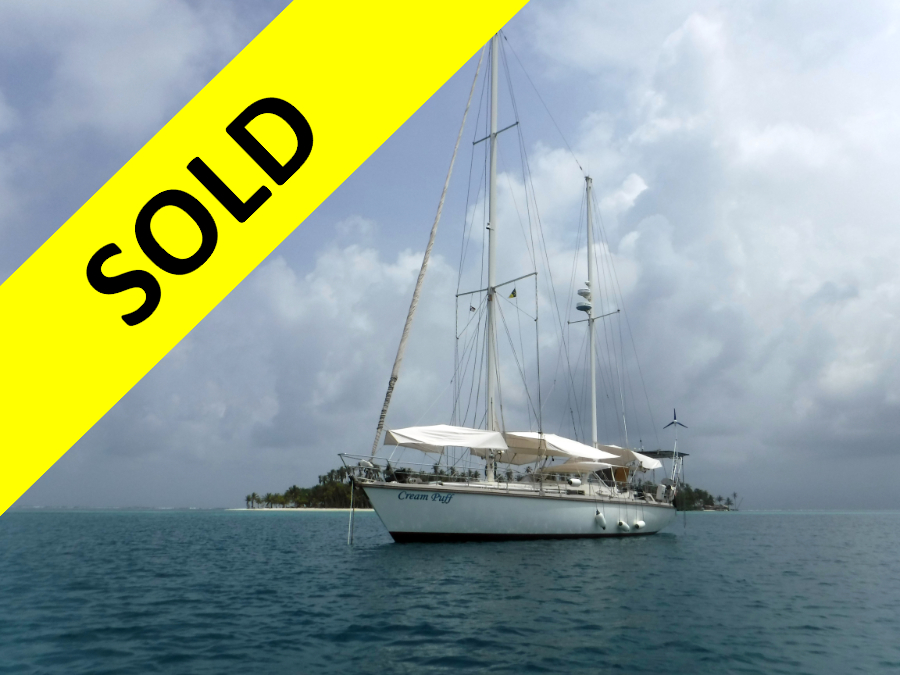
Yes, you read that correctly.
Wow… right!
Big news.
Cream Puff is officially sold.
This means we’re officially homeless. Nope, we do not have a home anywhere. Challenge on.
We’ve owned our Amel since 15th July 2011, some fifteen years ago. For the past twelve years, Cream Puff hasn’t just been our boat. She’s been our home. Selling her wasn’t an easy decision, and if I’m being completely honest, we’re still not 100% sure we’re ready to say goodbye. We’re fairly sure… but there’s still that little voice in the back of both our minds asking, “Are you really doing this?”
When we bought Cream Puff, there was never a grand master plan. We weren’t trying to sail around the world or tick countries off a list. There was no finish line and no timetable. The plan was rather simple: sail while it was still fun. Go where the wind blows us.
Most people jumping into this lifestyle last only about 2 years. It is either not what they thought the life would be or more expensive than they imagined. I blame the sailing media hounds for the false narratives and pictures of an everything-is-rosy lifestyle. It’s a tough lifestyle. Yes, there are rewards, but it is not for everyone.
We figured maybe five years. Then maybe ten. It turned into almost twelve years. Twelve years of full-time cruising. Twelve years of incredible places, wonderful people, occasional disasters, endless maintenance, and memories we’ll carry for the rest of our lives.
The Sale
The sale itself went surprisingly smoothly and very quickly.
- The very first person to look at the boat bought her. Ironically, we were the first people to look at her when we were shopping.
- We only advertised in Australia using YachtHub. I put a single post on Facebook in an Amel owners group, where the new owner noticed.
- We didn’t use a traditional broker, although we did pay one a fixed fee to help facilitate the paperwork and escrow the funds. We paid a flat rate of about US$1,500 for the broker to handle paperwork and customs procedures.
- The buyer commissioned a full, extensive survey.
- The boat was accepted exactly as she sat.
- Everything went with her. And, I mean everything.
We sold Cream Puff fully equipped for her next adventure. When we bought her, she was almost empty. We didn’t even have the basics—plates, pots and pans, towels, tools… nothing. We decided to do the opposite. The buyer simply needs to turn up with a duffle bag of clothes, buy some groceries, and he can head off sailing.
Everything included our Sailrite industrial sewing machine, an enormous collection of tools, tons and tons of spare parts, linens, galley equipment, and countless bits and pieces accumulated over more than a decade afloat. The inventory aboard even includes parts needed for the next two haul-outs to do maintenance on the prop and bow-thruster.
One of the real pluses that made Cream Puff an attractive purchase is that our philosophy was always to replace rather than repair whenever it made sense. It wasn’t the cheapest strategy, but it meant the boat was always ready to go. We watched too many boaters spend their time fixing the same things over and over again. So, if something broke on the Puffster, it was rarely repaired. It was replaced. My thought was that the original part lasted for years without trouble, so a new part should do the same. I don’t like fixing things twice.
The Real Cost
For the very first time, I am posting the true cost of this wacky lifestyle.
People consistently underestimate what it costs to cruise full-time. They see the anchorages and sunsets but not the endless maintenance, upgrades, haul-outs, insurance, customs fees, and those stretches where you’re stuck in a marina or boatyard fixing something expensive.
The single biggest mistake people make when entering this lifestyle is underestimating the cost. Then they run out of money. They “research” how much they will spend and then make the fatal mistake of thinking they can do it for less.
There are a lot of bloggers and vloggers online who simply mislead others about the true cost of full-time cruising. If they told people it is expensive and out of their reach, nobody would watch their channels. Their goal is to try to sell the dream so people continue to tune in. They get paid by the clicks.
Some will try to convince people that traveling by boat can be done for less than $25k per year. I call bullshit on this. These are the people without insurance, not doing boat maintenance to keep the boat seaworthy and safe, and not having the budget to explore beyond where their feet can carry them when visiting new lands. They are constantly fixing things since they refuse to buy a new part, and then they wind up in what we’ve coined as “boat jail.”
Boat jail is when a person has too little money to fix their boat to make it seaworthy; they’re stuck in some remote place, have a life of self-inflicted hardship, refuse to get a job and save some more money (or perhaps their visa prevents them from working), and basically become a hermit in the anchorage. We’ve seen this much too often.
I should add here that if this is how people choose to live, more power to them. I am not judging. I’m just asking future wannabe cruisers to be realistic in their expectations so they don’t add to the huge number of people who don’t make it past two years.
So this is it. This is what our wacky sailing adventure cost over almost twelve years. I suspect a few people will be surprised.
The total cost was US$1,008,124. This includes everything. We tracked our expenses to the exact penny. All of our expenses. Yes, we live a comfortable life aboard our boat. Better than others. Not as good as some. If we factor in the boat’s depreciation over this period, the real amount is US$1,143,124.
It’s been worth every penny!
Our last ocean passage from Australia to New Caledonia was a beautiful 5 days of sailing. A great last passage…
So… What’s Next?
This is where things get interesting.
Most cruising blogs simply stop. One day they’re anchored in paradise. The next… silence. No explanation. No goodbye. It’s almost as if the people disappeared. We’ve always thought that was a shame. The sailing adventure may be ending, but life certainly isn’t.
So we’re going to keep writing.
This blog will simply become something different.
Instead of sailing the world, it’ll be about learning to live on land again, choosing where that land will be, and adjusting to an entirely different lifestyle after twelve years afloat.
Our immediate to-do list looks something like this:
- Decide which country.
- Find somewhere to live.
- Obtain the appropriate visa if it isn’t the USA.
- Move our belongings.
- Learn the language.
- Make friends.
- Continue to travel the globe.
Simple, right?
The Big Decision
Most cruisers eventually return to where they started. Usually it’s to be closer to family—especially children and grandchildren. Others choose another adventure altogether. We’ve met people who swapped oceans for the canals of Europe and now happily cruise around on barges. A few people we know kept their homes and rented them for income while on the boat.
Not us.
Throughout this entire journey, we’ve constantly asked ourselves what comes next.
We’re still asking.
The easiest option would be to return to the United States. Within a couple of months, we could probably buy a house, unpack our belongings, put up a Christmas tree, adopt a dog… or two… and settle into retirement.
We’ve never really been known for taking the easy road.
If we returned to the US, there are only a handful of places we’d seriously consider—parts of Washington, Oregon and Northern California. No other location appeals to us.
But we’re also attracted to the idea of starting a completely new chapter somewhere else.
Why It’s Not That Simple
One of the biggest factors is taxation.
Both of us are US citizens (I’m also a UK citizen), which means the United States taxes us regardless of where we live. The US is one of only two countries in the world that taxes non-resident citizens. The other is Eritrea. An African country that nobody can point to on a map.
If we settle overseas, it really needs to be somewhere with a tax treaty that prevents double taxation. This immediately narrows the list.
Fortunately, there are still plenty of attractive possibilities. There are countries that welcome retirees, offer relatively straightforward long-stay visas, provide excellent and affordable healthcare, maintain a high standard of living, and have thriving English-speaking expat communities while we learn the local language. We simply have to decide which one feels like home.
We still have the travel bug. We’d like to live somewhere where we can travel to awesome places and take in the sights. Sitting in a recliner and watching The Price is Right every morning is not in the cards for us yet.
Our criteria make choosing an island retirement destination, like Malta, perhaps less appealing than somewhere with easy access to the rest of Europe. Malta is an excellent retirement spot that offers a tax haven as well as top-notch affordable healthcare. We can live pretty comfortably there on a similar budget to that of sailing. Thanks to my UK passport, Ireland remains an interesting possibility and would make an excellent base. It could also serve as a gateway into the EU since the stupid Brexit thing.
As we sailed around the world, we’d often joke about moving permanently to whichever country we happened to be visiting. At one stage I was convinced it would be New Zealand. Beautiful country. We learned quickly that we would like to live there.
Then we discovered Australia. For the first time, we both looked at each other and agreed: “Yes… we could live here.” Sadly, unless you have an absolute shit-ton of money, Australia doesn’t really have a practical retirement visa. So… the search continues. And, I think the double taxes would kill us.
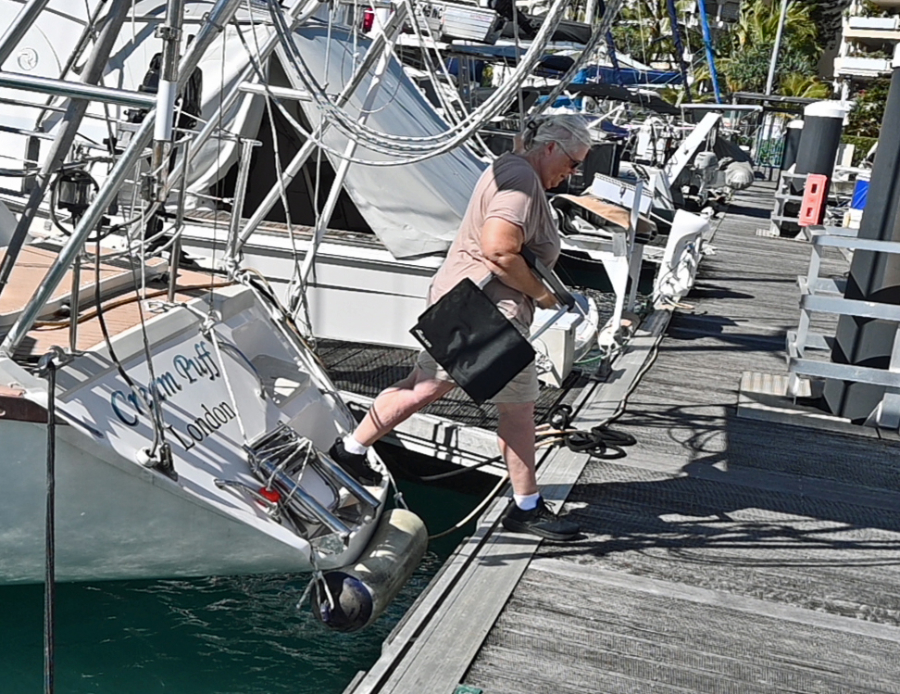
Cindy steps off Cream Puff for the last time.
Goodbye, Puffster
I know she’s just a boat. An inanimate object. But it genuinely makes me happy knowing Cream Puff will continue doing exactly what she was built to do. The new owner has plans to sail the oceans and keep cobwebs off the rigging.
The only thing changing is who’s standing behind the wheel.
I used to joke on this blog that if we stayed in port too long, Puffster would start tugging on her dock lines because she was anxious to get moving again.
I suspect she’s doing exactly that now.
There’s an old saying that the two happiest days in a boat owner’s life are the day they buy the boat and the day they sell it.
Well…
I absolutely loved the day we bought Cream Puff. It was terrifying, exciting and life-changing all at once.
I’m not loving the day we sold her. I’ll write more on this later. It’s too hard right now.
We still love this lifestyle. But we’re not getting any younger, and we’re slowly running out of places we’ve always dreamed of sailing. Maybe in a few months we’ll feel differently. We’ll see.
One thing is certain. The adventure isn’t over. It’s simply changing course.
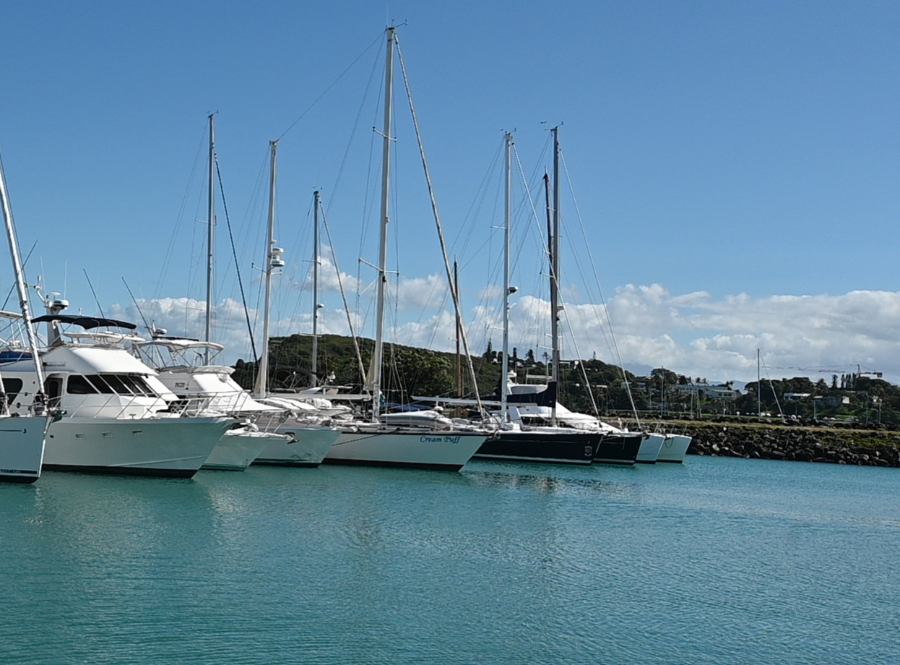
A last look back. This is our final photo of the Puffster as we walk away from cruising life. Yes, there were some watery eyes taking this.